
This blog post is more ‘thought experiment’ than ‘thought through’. Let’s see whether it works.
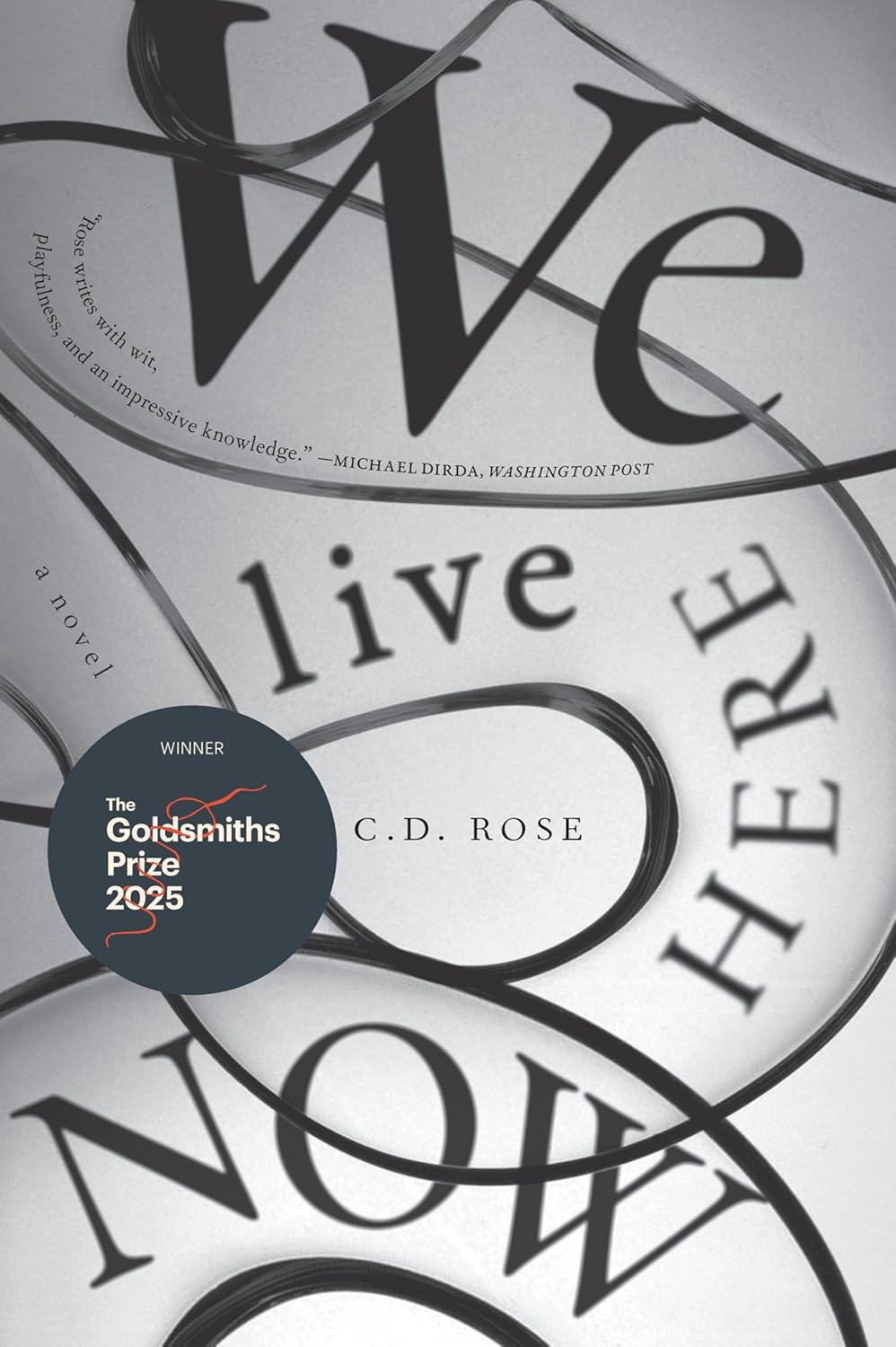
C.D. Rose’s We Live Here Now (Melville House, 2024) won the 2025 Goldsmiths Prize for experimental fiction. It comprises fifteen chapters, the stories of which are not told strictly chronologically—’They could we think later, be seen in any sequence.’1—that all interlink in some way. We Live Here Now stretches and tests the definition of ‘novel’.
Together, they tell a story about the mysterious artist, Sigismunda Conrad, and her return to public consciousness. Across the whole text, the reader identifies motifs of art/aesthetics, capitalism, and disappearance.
In this brief post, I want to sketch a comparison between Rose’s metamodernist (or post-postmodernist) novel and J.G. Ballard’s postmodernism. In particular, while reading the penultimate chapter of We Live Here Now I was reminded of Ballard’s 1969 novel The Atrocity Exhibition.
The Atrocity Exhibition
The Atrocity Exhibition contains short entries in what might be read as a novel, or as an exhibition catalogue.
If a novel, it ‘tells’ the ‘story’ of Travis/Travers and his evolution through medicalised psychosis, as charted by medical doctors and witnessed by his wife and others.
But ‘the atrocity exhibition’ is also a metaphor in the novel. It defines the way that Travis views the human body as an ‘asymmetric’ organism that needs correcting through World War III.2
Or the ‘Atrocity Exhibition’ is an exhibition which uses celebrities to ‘mimetize’ ‘the atrocities of Vietnam and the Congo’ (p. 12). The celebrities could in fact be the atrocity.
The book is populated by a host of characters, often 1960s celebrities, and it’s sometimes difficult to follow the twisting threads of narrative—not least because the main character evolves and changes name in the course of the book.
We Live Here Now
We Live Here Now is also populated with celebrities, but this time contemporary and modern artists. The fact that many of the chapters are about making art also places it in the realm of an exhibition catalogue.
The penultimate chapter brings together many—if not all—the main and periphery characters back together: ‘Everyone was there.’ (p. 274) They’ve come to see scientist–philosopher Lukas Lemnis give a talk, where Conrad’s new and old artwork is rumoured to be on show.
As with many other characters or aspects of the novel, Lemnis’s exact presence is difficult to establish. Is he one or a group of people (he is one)? Does he give talks himself or commission others to give them (both. Today, actor Joe Coyle will deliver the talk)? Does anyone know what he looks like (no)?
The event turns chaotic:
Joe Coyle was telling anyone he could that he was Lukas Lemnis and he needed ot make a speech, but no one was listening to him. The fire alarm was still going off in Lukas Lemnis’s room[. …]
People kept appearing but they couldn’t understand each other. Silas was sure that there were at least twelve versions of his uncle Thomas. Zinnia Laerp was in three different places at the same time. Outside, a fleet of large black cars pulled up. A cloud snaked into the building then hung over the heads of everyone there, slowly gaining mass. […]
A ship, on fire, appeared on the wall. Some people, dressed in black, were dancing. More people arrived. (pp. 291–2)
This is the end of the chapter, and the reader is left as confused as ever heading into the last chapter, which contains a newspaper review of Conrad’s latest work.
Atrocity
When Ballard uses the phrase ‘Atrocity Exhibition’, in any of the contexts of the novel, the ‘atrocity’ is something comprehensible to a modern reader. However, that can’t always be true if I apply it to C.D. Rose’s novel.
Unless, that is, we can restore some of the word’s etymological heritage.
In the dark recesses of its history, the word ‘atrocity’ comes into English from the Latin atros citas, meaning ‘cruelty’. Even further back, it probably comes from an Indo-European root meaning ‘fire’.
Looking at the passage I just cited from We Live Here Now—where a (fake) fire threatens to overwhelm the event—there might be a way of thinking of this novel as a new Atrocity Exhibition.
Ballard’s novel exposed the inadequacies of uncorked sexuality after the Second World War. It also revealed the proliferation of images of vulnerability and war that provided a basis for contemporary society.
Rose’s novel doesn’t do that; however, I felt that its parade of ill-fitting characters, its confusion between the market and the artistic impulse in twenty-first-century society, and its refusal to allow a ‘conventional’ narrative to form, revealed something else about civilisation: that where we live now is a world without centre, circling an atrocious fiery black hole of meaninglessness, all the while we struggle to find meaning in anything.
Leave a Reply
You must be logged in to post a comment.