
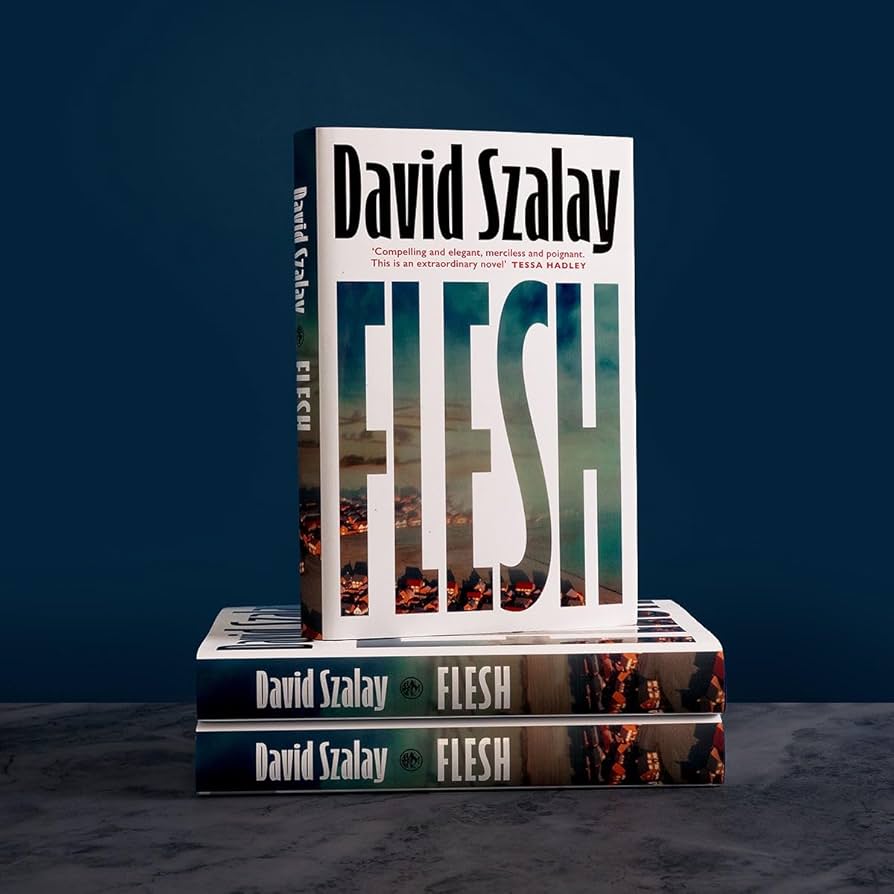
In winning the 2025 Booker Prize—Britain’s self-pronounced most important fiction prize—David Szalay’s Flesh (Jonathan Cape, 2025) was praised for its spareness.
Chair of the judges, Roddy Doyle, said that
we don’t know what the protagonist, István, looks like but this never feels like a lack; quite the opposite. Somehow, it’s the absence of words – or the absence of István’s words – that allow us to know István.1
Flesh‘s detached writing style is deliberate and shepherds the reader away from their emotions. It is far from the heart-wringing of 2023’s Booker winner, Prophet Song by Paul Lynch, when the protagonist Eilish discovers her child’s body in a public morgue.
The plot of Flesh has its share of poignant, dramatic, and life-changing moments. The protagonist, István, continuously suffers from the universe’s hatred: deaths pile up, whether his neighbour’s, his military comrade, his employer, his wife and child, or his mother.
His misfortune reminded me of the tragic life of John Williams’s William Stoner.
And yet István’s life goes on, in a kind of rejection of a ‘coming-of-age’ novel structure. It’s not that nothing happens to István. Rather that everything happens—more than will happen to most people—but nothing rocks the text’s equilibrium.
The tragic and dramatic become stylistically the ‘everyday’. The narrative structure avoids peaks and troughs. It becomes quotidian.
Fiction of the everyday
There are two possible ways to interpret my idea of ‘quotidian narrative’.
The more obvious is that the narrative includes the everyday as part of its narrative. This literary phenomenon has begun to receive critical attention, for instance Saikat Majumdar’s Prose of the World: Modernism and the Banality of Empire (Columbia UP, 2013), or Jonathan Hay’s Science Fiction and the Posthuman in the Anthropocene (Bloomsbury, 2024).
These arguments share a belief that the everyday or quotidian are not negligible because they are common and ordinary. Rather everyday significance emerges out of its ordinariness. Readers should question what is ordinary and how it became ordinary, because the quotidian dictates more obviously how we live from day to day. We don’t legislate for the extraordinary, however much we might hope for it.
But I am more interested in a second interpretation of ‘quotidian narrative’. It’s the idea that the style of the narrative voice makes even the consequential event or massive life-change seem insignificant in the narrative.
Imagine a nuclear bomb going off in a book, and the writer tells the reader about it without evoking a sense of fear, or trepidation, or shock. As if a nuclear bomb goes off everyday.
It’s close to the idea that Maurice Blanchot, French novelist and philosopher, wrote about in his novel L’Arrêt de Mort (1948; trans. Death Sentence). Of this, Kristin Ross writes:
[The quotidian’s] repetitive temporality is such that nothing takes place, but everything is on the verge of taking place—on the point, that is, of erupting into history.2
The nuclear bomb, in my example, isn’t elevated in the story because it is in some way neutered or made to feel ordinary. The narrative refuses to disrupt its flat emotions, threatening only that maybe tomorrow the nuclear bomb will have become interesting.
This is the kind of quotidian narrative that Szalay uses in Flesh.
Quotidian flesh
There are three obvious places where this happens in Flesh.
In the opening section, István becomes legally culpable for the death of a neighbour. The teenage protagonist is unsure whether he killed his neighbour—with whose wife he had been having casual sex—but Istvan knows enough to run away before questions can be asked.
The police catch up with him and he is arrested. Only a page or two after he learns of the neighbour’s death, there is a section break. The reader is then introduced to István after his release from a young offenders’ institute: it is as though the death—the potential murder—never properly took place.
As a reader, I expect to see the emotional consequences and personal turmoil of this death—but that doesn’t happen.
A second significant death is his employer, Karl Nyman. This death paves the way for Istvan to marry Karl’s widow, Helen, with whom he had been having an affair. But the death takes place between sections, and there is no emotional pay off after thingamee’s death.
In fact, the narrative skips seven years. The death appears to matter that little to István’s emotional sensibility.
A third moment is the most significant, when Istvan’s wife Helen and child, Jacob, die in a car accident . We read that ‘He desperately wants to believe that his son still exists […] and that what happened to him is somehow part of some larger plan or scheme, and not just a meaningless single event’ (p. 318), and then that ‘He’s also suddenly very aware of the fact that Helen is dead, or his perception of the fact that she’s dead changes. There’s a deep immovable sadness there that wasn’t there before’ (p. 338).
These last examples solidify one thing, and clarify another. They solidify that the narrative voice will refuse to rise to meet the tragic occasion. Muted factuality (‘a deep immovable sadness that wasn’t there before’) will reign.
They clarify, on the other hand, that István is emotionally alive, proven in his uncontrollable hysterics when, back in Hungary, he considers buying a puppy, just as Jacob always wanted:
It has been a long time, more than a year, since anything like this has happened. And it’s not quite over yet. [… H]e starts to sob again. (p. 337)
Finally we know that István does feel things in a way that matches the gravity of the event.
An everyday fight
Flesh stages a contest. In one corner stands István, beaten back by chance and steadily growing into a human, feeling being.
In another corner, the narrative voice wants to dull the characters’ emotions and wants to keep the style steady. On pages 308–10 we see the contest become real when two/three blank (but numbered) pages are inserted into the novel, just after details are given about Helen and Jacob’s car crash. This, I think, shows István’s attempted mastery at expressing his own experience of life.
The immediate response to the crash is typically cold:
You don’t know what to do when something like that happens
The shock is so great
He just sits on a chair
He ends up sitting there all night (p. 307)
As to who wins the contest, the following extremely ordinary lines confirm, I think, that style defeats character:
When it’s over he sits on a bench. The dry petals of chestnut flowers fall onto the path. They move on the asphalt with a papery sound, and when the wind stops they lie still. He watches them for a while. Then he stands up and walks back to the flat. After that he lives alone. (Szalay, p. 349)
- See https://thebookerprizes.com/the-booker-library/prize-years/2025. ↩︎
- Kristin Ross, ‘Two Versions of the Everyday’, L’Esprit Créateur, 24.3 (1984), 29–37 (37). Available at : http://www.jstor.org/stable/26284069. ↩︎
Leave a Reply
You must be logged in to post a comment.